
After the Gold Rush: Why Productive Assets Still Win the Long Game
Executive Summary
During the Gold Rush of 2025, the price of gold rallied 65% as investors and central banks accumulated over 1,600 metric tonnes. Gold continues to capture the attention of investors. In this report, we consider gold as an investment, and how gold has historically compared to ownership of productive businesses, those that generate dividends, cash flows, and earnings. We acknowledge that an allocation of gold can have a positive role during inflationary periods as well as during US dollar weakness. However, predicting when inflation will rise or when the US dollar will decline has proven very hard and difficult to do consistently. For long-term-oriented investors, we conclude that owning a broad and diversified portfolio of equities, bonds, and real estate is our preferred way to invest.
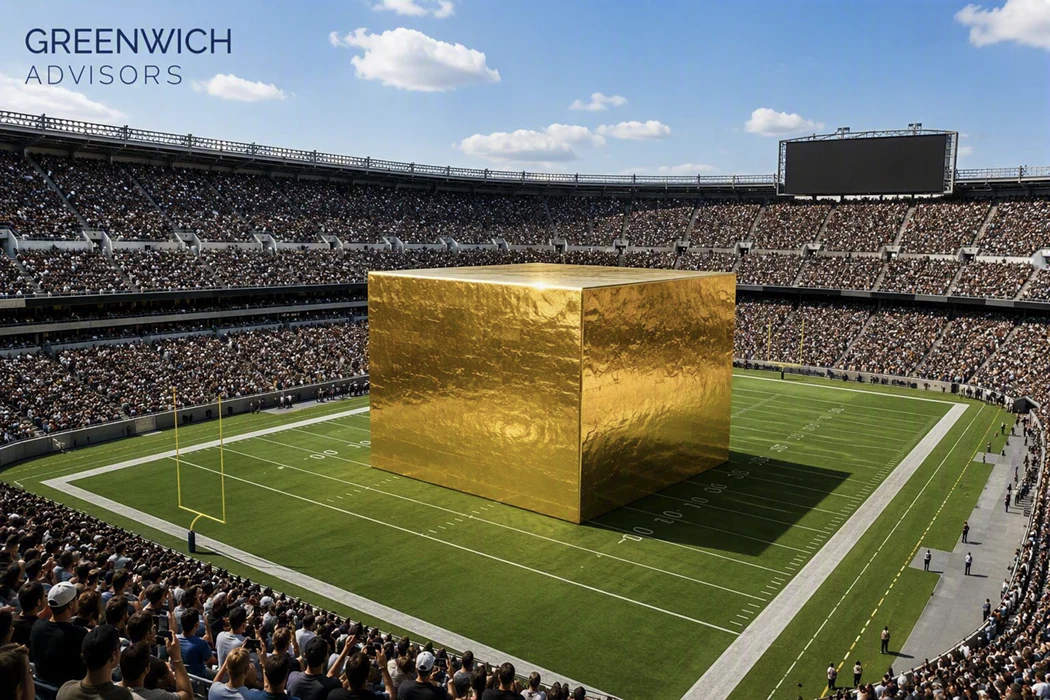
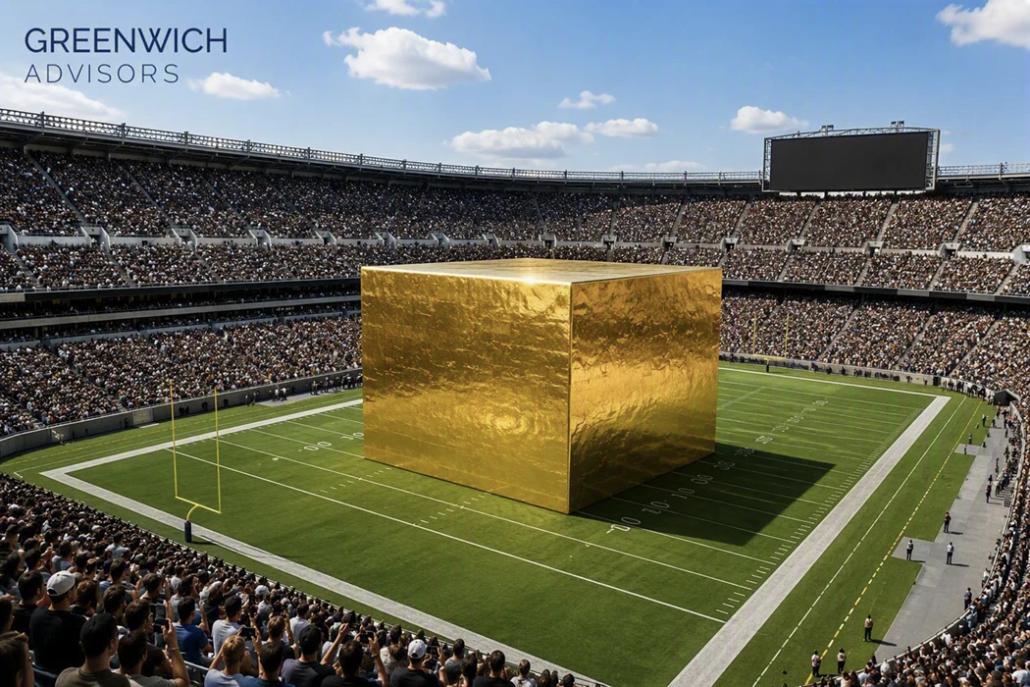
Figure 1. Conceptual representation of all the gold ever mined in the world, at today’s prices valued at $33 trillion and which fits on a football field as a 22.5m cube.1 AI-generated, not exactly to scale.
Gold’s Historical Context
Gold is shiny, scarce, does not rust, can be melted into almost any shape, and has fascinated humans for thousands of years. If metals held beauty pageants, gold would be the perennial champion. These characteristics helped it earn a reputation as a trustworthy store of value long before the advent of the modern financial system.
Under the classical gold standard, currencies were directly redeemable for a fixed amount of gold. The U.S. dollar, for example, was legally convertible into gold, and the Federal Reserve was required to maintain substantial gold reserves backing the currency it issued. However, the relationship between gold and money changed dramatically during the Great Depression. Concerned that gold hoarding was deepening the economic crisis, President Franklin D. Roosevelt issued Executive Order 6102 in 1933 requiring most Americans to surrender their gold to the Federal Reserve!2 There is precedent for the U.S. government confiscating domestic gold.
Later, President Nixon suspended the gold-backing of the dollar, effectively ending the gold standard and ushering in modern fiat currency which we use today. Without the backing of gold, currency relies on public confidence in the issuing body (e.g., the U.S. government) to ensure its value. This transition fundamentally altered the role of gold. So, what is the use for gold today?
Gold in 2025: Institutional Demand
Gold’s sharp rise in 2025 was driven largely by central bank and investor demand. Central banks accumulated 863 metric tonnes of gold last year, double the 400-500 metric tonne annual average seen through the 2010s.3 At the same time, investors accumulated 801 metric tonnes via exchange traded funds (or ETFs), the second-strongest year on record. When demand outpaces supply, prices rise.
High prices, however, change the math for miners. Many mining operations produce gold for $1,800 to $1,900 per ounce all-in, meaning when gold trades for less than that it is unprofitable to mine.4 At $4,500/oz, however, generous profit margins turn previously uneconomic mining projects into attractive investment opportunities. Higher prices mean more exploration, more ore mined, and more gold produced.
A heavy-industrial supply response takes years to play out, but if central-bank buying and ETF inflows continue, prices can continue to rise. If that institutional demand cools while new mine supply keeps arriving, you could have an environment with excess gold coming to a market with fewer buyers, pushing prices down. The very demand shock that drove gold higher may produce the supply shock that causes prices to decline.
Gold in 2026: Wealth Storage
As we write this report, gold remains debated among investors. After surging to an all-time high above $5,300 per ounce in January, gold has since retreated to roughly $4,500 per ounce. Even after its pullback, gold prices remain elevated by more than double its price through much of the 2010s.
Gold’s rise tells us more about investor demand than about economic utility. Roughly 40% of all the gold ever mined is held by investors and central banks, where it performs no productive function whatsoever. Another 45% resides in jewelry. Together, this share (85%) effectively reflects all the gold used for “wealth storage.” Only ~14% of the world’s gold stock is employed in industrial, technological, medical, or other applications where its unique physical properties create direct economic utility.5
Global Gold Supply by End-Use: Wealth Storage vs. Utility
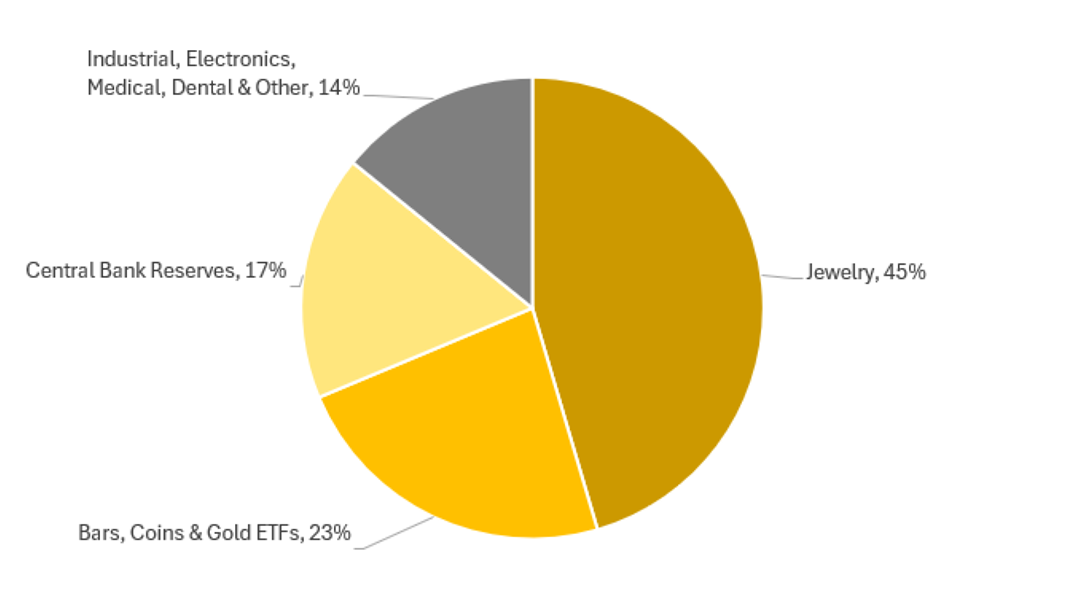
Figure 2. Percentage of the world’s above-ground gold supply by end-use; ~85% of all gold in-use today is attributable to “wealth storage” functions with limited industrial utility.
While gold largely preserves wealth, productive businesses compound it. Investors seeking to grow purchasing power have historically been far better served owning the engines of human productivity represented by great businesses. The opportunity cost of investing in gold over long periods of time rather than a broad-market index such as the S&P 500 has been enormous. $10,000 invested in gold since 1975 grew to $196,050 while the same $10,000 grew to $842,160 when invested in the S&P 500 (see Figure 3 below).
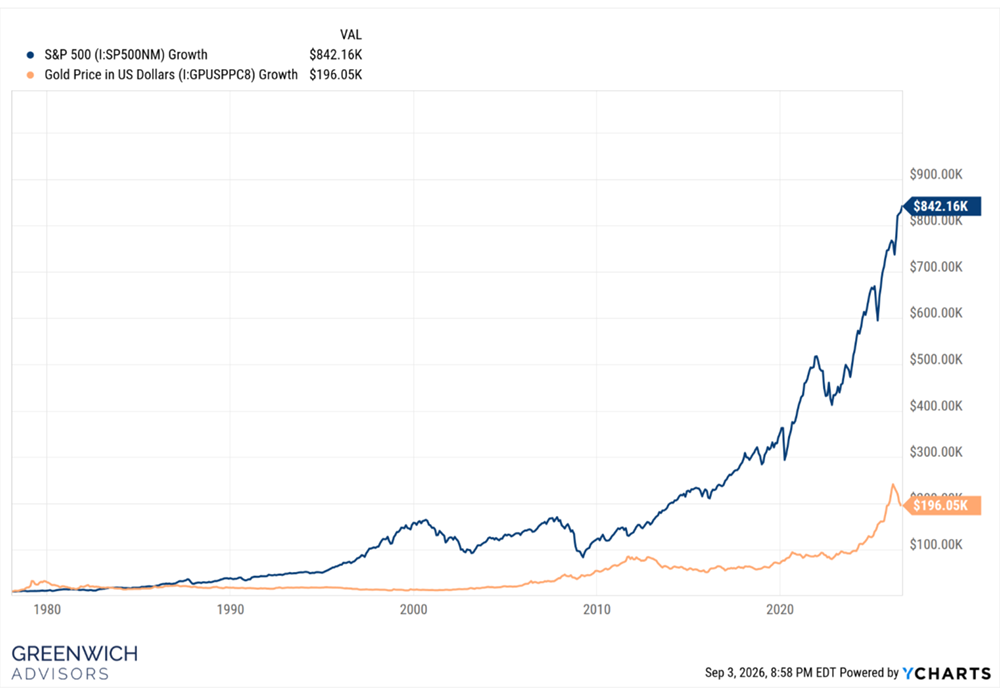
Figure 3. Historical growth of equal investments in S&P 500 compared to gold from 1975 to date.
The gains in gold we see today reflect investor expectations of gold’s perceived ability to store wealth, not any change to its intrinsic value or utility itself. When confidence wanes, investors seek assets insulated from corporate earnings, government promises, or a central bank’s balance sheet. War, tariffs, global oil shocks, and shifting Federal Reserve policy all reinforce the current gold narrative and contribute to the current rally. The real challenge is determining whether reassurance itself is worth $4,500 per ounce.
The Choice: Gold or Productive Assets
Imagine taking all the gold ever mined, all 220,000 metric tonnes of it, and smelting it into a cube. That cube would be worth $33 trillion and measure roughly 22.5 meters per side. It would be marvelous to behold, but would it be a good investment? This line of questioning naturally brings us to the crux of investment philosophies. We align ourselves with Warren Buffet’s definition of investing “as the transfer to others of purchasing power now with the reasoned expectation of receiving more purchasing power – after taxes have been paid on nominal gains – in the future.”6 Stated otherwise, an investment is putting money to work now in the hope that it will grow enough to increase what you can buy later, after taxes.
Gold is purchased in the hope that someone else will pay more for it later.7 Meanwhile, businesses and farms are valued on the goods, services, and foods they produce. Taxation does not help gold’s case either. Under the U.S. tax code, gold is treated like a collectible, along with rare coins, artwork, and antiques. Unlike stocks and real estate whose gains are taxed at 15% – 20%, the gains on gold can be taxed at rates up to 28%.8
So now, let us revisit the original question: would owning all the gold in the world be a good investment? Alternatively, we propose that for a similar sum, an investor could acquire ownership stakes in many of the world’s largest and most productive businesses. Which do you pick?
All the Gold in the World or $33T of Industry and Farmland?
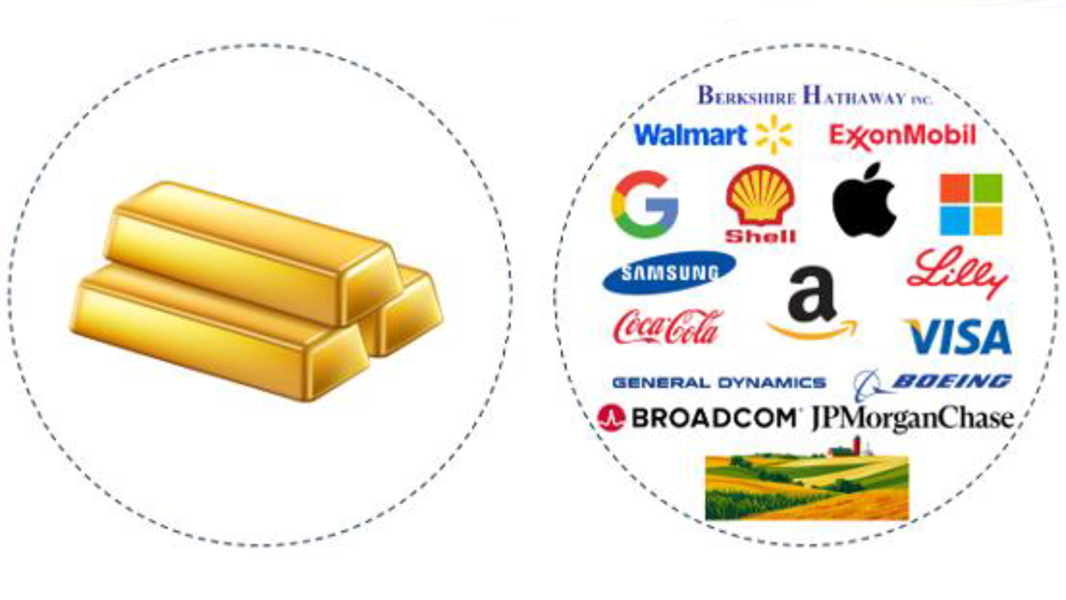
Figure 4. Illustration of the buying power $33 trillion affords; either (1) all the gold in the world or (2) a selection of the most valuable companies and real estate in the world.
At Greenwich Advisors, we say take that $33 trillion, and instead own a collection of the world’s most productive businesses, ones that get up every morning, hire people, invent things, sell to the world, and compound their earnings year after year. You will also have enough left over to buy all the farmland across eight U.S. midwestern states and still have trillions left over. We do not view gold as a wealth-creating asset. However, we recognize that some investors are willing to accept lower long-term return potential in exchange for potential short-term gains and the peace of mind gold may provide during periods of uncertainty. Given the choice, we’ll take the productive assets every time.
We do not claim to know where gold will trade next. It may perform well this year, and a limited allocation may fit certain actively traded portfolios. We do caution that if you want to speculate with a position in gold then do so with an amount suitable for your level of risk and certainly no more than 5% of your portfolio. We would prefer to own equities, real estate, and bonds because profits earned from productive assets can shine just as bright as a gold bar. Every investor’s circumstance, objective, and risk tolerance are unique and we understand that. Contact us, to determine how gold versus productive assets aligns with your specific goals, time horizon, and financial plan.
– Alex Tucker & D. Chris Tucker, CFA
DISCLAIMER: The information contained in this e-mail is proprietary, confidential, and intended solely for the person to whom it is addressed. If you have received this message in error, notify the sender immediately and delete the original message. Certain information contained herein, although believed to be reliable, has not been independently verified, and its accuracy or completeness cannot be guaranteed. The information contained herein is for illustration and discussion purposes only and is not intended to be, nor should it be construed as investment advice or an offer to sell, or a solicitation of an offer to purchase securities of any fund managed, or to be managed by Greenwich Advisors, LLC.
1 World Gold Council, Gold Market Primer: Market Size and Structure. www.gold.org/goldhub/research/marketprimer/gold-market-primer-market-size-and-structure
2 Exec. Order No. 6102, Forbidding the Hoarding of Gold Coin, Gold Bullion and Gold Certificates, Apr. 5, 1933. presidency.ucsb.edu/documents/executive-order-6102
3 World Gold Council, Gold Demand Trends: Q4 and Full Year 2025. gold.org/…/gold-demand-trends-full-year2025/central-banks
4 World Gold Council / Metals Focus, Gold Mine Cost Service, AISC dataset and cost. gold.org/goldhub/data/aisc-gold
5 World Gold Council, How Much Gold Has Been Mined? gold.org/goldhub/data/how-much-gold
6 Warren E. Buffett, Berkshire Hathaway Inc. Letter to Shareholders, Feb. 25, 2012. www.berkshirehathaway.com/letters/2011ltr.pdf
7 Buffett, 2011 Letter to Shareholders
8 IRS, Topic No. 409, Capital Gains and Losses. irs.gov/taxtopics/tc409

